
Concrete Demolition · Tool Selection Guide
Choosing a Concrete Breaking Tool
Paving breaker, rivet buster, or chipping hammer? The right answer comes down to two questions: which way the tool points, and how thick the concrete is. This guide settles both in about five minutes – with verified specs from the tools on our shelf, not brochure copy.
Start With the Job, Not the Catalog
Every concrete-breaking decision starts the same way: what are you breaking, and which way does the tool have to point?
A concrete breaking tool is a handheld percussion tool – a paving breaker, rivet buster, or chipping hammer – that hammers hardened steel against concrete to break, cut, or scale it. The right family depends on the orientation of the work and the thickness of the concrete.
Slabs, driveways & roadways
Bridge decks & horizontal demo
Overhead & wall work
Surface prep, scaling & patchwork
Trenching & frozen ground
The 5 Decisions, In Order
Work through these in sequence and the catalog picks itself.
Which way does the tool point?
Orientation is the fastest filter. Paving breakers only work straight down. Rivet busters and chipping hammers are built to be held level or overhead.
| Down | Paving breaker |
| Horizontal | Rivet buster |
| Overhead | Rivet buster or chipping hammer |
How thick is the concrete?
The old field rule still holds: match breaker weight to slab depth – a 40 lb breaker for 4 in, 60 lb for 6 in, 90 lb for 9 in.
| Under 2 in | Chipping hammer |
| 2-6 in | Rivet buster or 40-60 lb breaker |
| 6 in and up | 60-90 lb paving breaker |
Energy per blow, or blows per minute?
Long strokes hit harder; short strokes hit faster. Mass demolition wants energy. Precision work wants rate and control.
| Max energy | Rivet buster, 680-1,140 BPM |
| Balanced | Paving breaker, up to 1,850 BPM |
| Max control | Chipping hammer, 1,500-3,200 BPM |
Can your compressor feed it?
Every family here is pneumatic. Check the CFM draw at 90 psi against your compressor before you buy the tool.
| Chipping | 20-36 CFM |
| Rivet buster | 33-50 CFM |
| Paving breaker | 34-85 CFM |
What steel does it swing?
Each family runs its own shank system. Steel and retainers are consumables – buy the system, not just the tool.
| Chipping | .580 hex / .680 round |
| Rivet buster | 11X Jumbo (.890 x 1.125) |
| Paving | 7/8 to 1-1/4 in hex |
The Three Families, One at a Time
What each tool actually is, where it wins, and where it is the wrong buy.
Paving Breakers (Jackhammers)
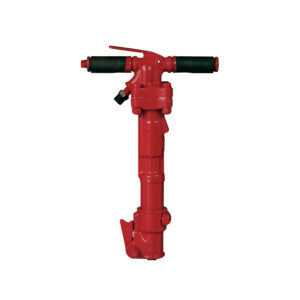
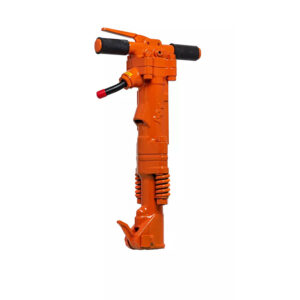
A paving breaker is a heavy, hand-held percussion tool – the jackhammer of the trade – that drives a moil point or chisel straight down to break concrete, asphalt, and frozen ground, and it is sized by weight class from 30 to 90 lb.
This is the tool for slab-on-grade, road beds, sidewalks, and foundations. You buy one by weight class, and the class does the arithmetic for you: the heavier the breaker, the deeper it breaks per blow. T-handle on top, moil point on the bottom, operator gravity in between. What it will not do is work sideways – lift the tool level and it stops being a paving breaker.
- Fastest way through slabs 4 in and thicker
- Weight classes from 30 to 90 lb – match class to slab depth
- Air, hydraulic, and gas power sources available
- Steel is cheap, standard, and everywhere: 7/8 to 1-1/4 in hex shanks
| Weight classes | 30-90 lb |
| Impact rate | up to 1,850 BPM |
| Air draw | 34-85 CFM @ 90 psi |
| Shank systems | 7/8, 1, 1-1/8, 1-1/4 in hex |
| Sizing rule | 40 lb per 4 in, 60 per 6, 90 per 9 |
| Wrong buy when | the work is horizontal or overhead |
Rivet Busters
A rivet buster is a handheld pneumatic demolition tool that drives a free-flying piston through a 6 to 11 inch stroke to hammer interchangeable chisels, punches, and moil points – breaker-class hitting power from a 24 to 39 lb tool you can hold horizontally.
Born to shear hot steel rivets, the rivet buster found its second career in concrete: it delivers the per-blow energy of a small paving breaker from a tool you can hold level or overhead. That makes it the default for bridge decks, beams, walls, tanks, and every structural job where gravity is not helping you. The long-stroke models hit hardest; the shorter strokes trade force for speed.
- Highest per-blow energy of any handheld tool this size
- Works horizontal and overhead – where breakers cannot go
- 6, 8, 9, and 11 in stroke options tune force vs speed
- One steel system across the class: 11X Jumbo shank
| Tool weight | 24-39 lb |
| Cylinder stroke | 6-11 in |
| Impact rate | 680-1,140 BPM |
| Air draw | 33-50 CFM @ 90 psi |
| Steel system | 11X Jumbo (.890 x 1.125 taper) |
| Wrong buy when | you are breaking thick slab straight down all day |
Chipping Hammers
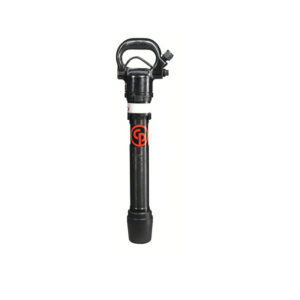
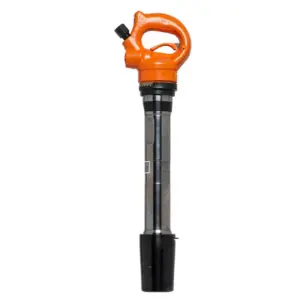
A chipping hammer is a handheld pneumatic tool that uses a free-flying piston to deliver 1,500-3,200 blows per minute for scaling, chipping, and light demolition.
The lightest family here, and the one you steer like a pencil. A chipping hammer will not drop a slab, but for taking off two inches of spalled concrete, cleaning a patch repair, dressing a cold joint, or chipping refractory, nothing else leaves as clean a substrate. Stroke length sets its personality: short-stroke tools chatter fast and shallow for finish work, long-stroke tools bite deeper per blow.
- 8-25 lb – all-day tools for detail demolition
- Fastest impact rates in the guide: 1,500-3,200 BPM
- Runs on small air: 20-36 CFM @ 90 psi
- Huge steel variety in .580 hex and .680 round shanks
| Tool weight | 8-25 lb |
| Cylinder stroke | 1-4 in |
| Impact rate | 1,500-3,200 BPM |
| Air draw | 20-36 CFM @ 90 psi |
| Steel systems | .580 hex / .680 round |
| Wrong buy when | you need to break more than a few inches deep |
Side by Side: Breaker vs Buster vs Chipper
The whole decision on one screen. Every figure below spans the live Crowder Supply lineup.
| Tool family | Weight | Impact rate | Air @ 90 psi | Steel system | Reach for it when |
|---|---|---|---|---|---|
| Paving breaker | 30-90 lb | up to 1,850 BPM | 34-85 CFM | 7/8 to 1-1/4 in hex | Slabs, roads, and foundations – working straight down |
| Rivet buster | 24-39 lb | 680-1,140 BPM | 33-50 CFM | 11X Jumbo | Bridge decks, walls, and overhead structural demo |
| Chipping hammer | 8-25 lb | 1,500-3,200 BPM | 20-36 CFM | .580 hex / .680 round | Scaling, surface prep, and precision chipping |
Two Proven Picks Per Family
Six tools we stock, spec-verified from their own product pages. Prices are live from the store.
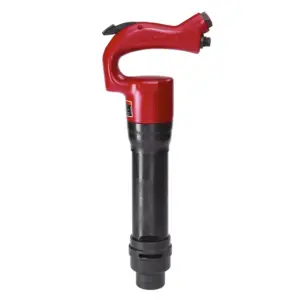
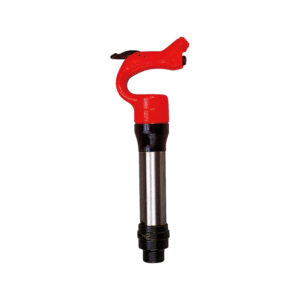
Prefer to browse everything? All paving breakers · All rivet busters · All chipping hammers
Concrete Breaking Tool FAQ
Straight answers to the questions we get on the phone.
What is the best tool for breaking concrete?
It depends on orientation and thickness: a paving breaker for slabs and anything you break straight down, a rivet buster for horizontal and overhead structural work, and a chipping hammer for surface prep and precision removal under a few inches deep. Get those two questions right and the tool family picks itself.
What size paving breaker do I need?
Match the weight class to the slab: a 40 lb breaker handles about 4 inches of concrete, a 60 lb about 6 inches, and a 90 lb about 9 inches. When in doubt between two classes, the heavier tool finishes faster but costs more operator fatigue – most road crews live in the 60 lb class. Our paving breaker buyer’s guide walks the full decision.
What is the difference between a rivet buster and a paving breaker?
Orientation. A paving breaker is built to work straight down with gravity; a rivet buster delivers comparable per-blow energy from a 24-39 lb tool you can hold horizontally or overhead. If the concrete is under your feet, use the breaker; if it is in front of you or above you, use the buster.
Can a chipping hammer break concrete?
Yes – within limits. A chipping hammer excels at removing the first few inches: spalled or delaminated concrete, patch-repair edges, coatings, and cold joints. It is not a slab tool; if you need to break through 4 inches or more, step up to a rivet buster or a paving breaker.
How much compressed air do these tools need?
At 90 psi: chipping hammers draw 20-36 CFM, rivet busters 33-50 CFM, and paving breakers 34-85 CFM depending on weight class. Size your compressor to the tool’s rated draw with some headroom – an underfed percussion tool loses impact energy fast.
What about clay diggers and pick hammers?
Clay diggers and pick hammers are the digging branch of the family – 20-30 lb D-handle tools for trenching, clay, hardpan, and frozen ground rather than cured concrete. If your job is more digging than breaking, start with our clay and trench diggers instead.
Does Crowder Supply stock steel and parts for these tools?
Yes. We keep moil points, chisels, retainers, springs, hoses, and oilers on the shelf for every family in this guide – and rebuild parts for the brands we carry: Chicago Pneumatic, APT, Texas Pneumatic, and Tamco/Toku. One call covers the tool and everything it swings: 1-888-883-5144.
Still deciding? Talk it through.
Tell us the job – slab, deck, wall, or surface – and we will point you at the right tool, the right steel, and the right air. No call center, just people who run these tools.
