
Crowder Supply · Buyer’s Guide
Break Concrete Faster With the Right Paving Breaker
Jackhammers are sized by the job, not the label. This guide walks the five decisions that pick a breaker — power source, weight class, shank, air supply, and operator protection — then shows the best model in each class with live pricing and a one-PO starter kit.
Start With the Job, Not the Catalog
A paving breaker is a heavy, hand-held percussion tool — the jackhammer of the trade — that drives a moil point or chisel straight down to break concrete, asphalt, and frozen ground, and it is sized by weight class from 30 to 90 lb and powered by compressed air, hydraulic oil, or a built-in gas engine.
Sidewalks, floors & tight spots
Bridge decks & plant upkeep
Pavement, asphalt & roadwork
Reinforced slab & foundations
No compressor on site?
The 5 Decisions, In Order
Work them top to bottom and the model almost picks itself. The first two set the tool; the last three make sure it runs and lasts.
Power source
What is already on the job decides this first.
| Air compressor | Pneumatic — widest choice, the default |
| Power pack | Hydraulic LH / BRK VR — low-vibration, no air line |
| Neither | Gas Cobra PROe / Red Hawk — goes anywhere |
Weight class
Weight sets blow energy; confirm with the 10-20 second field check.
| 30 lb | Floors, sidewalks, confined |
| 40 lb | Decks, plant maintenance |
| 60 lb | Pavement, asphalt (default) |
| 90 lb | Reinforced slab, foundations |
Shank ecosystem
Match the hex your crew’s steel already uses.
| 7/8 x 3-1/4 | 30 lb light standard |
| 1 x 4-1/4 | 30-40 lb, most common |
| 1-1/8 x 6 | 60-90 lb heavy #1 |
| 1-1/4 x 6 | 60-90 lb heavy #2 |
Air supply
Beat the tool’s CFM with headroom at 90 psi at the tool.
| 1 breaker | 90 CFM towable |
| 2 heavy | 185 CFM towable |
| Main hose | 3/4 in ID |
| Whip | 1/2-3/4 in ID + oiler |
Operator protection
Daily production use makes these the real spec.
| Vibration | Airgo-Line, SVR, PE, RTEX trims (HAVS) |
| Silica | Dust collection + wet methods |
| Noise | Silenced models / muffler kits |
Crowder Supply – Product Knowledge
How a Paving Breaker Works
Every number on a breaker spec sheet — bore, stroke, BPM, CFM — comes from one simple cycle repeated 11 to 30 times a second. The operator does not swing anything; a free-flying piston does the striking while the tool’s own weight holds the steel to the work.

Exploded view of a pneumatic paving breaker.
The operating cycle
- Air enters at the inletCompressed air at 90 psi passes the throttle valve when the operator squeezes the lever.
- An automatic valve ports the airA small oscillating valve sends air alternately above and below the piston — no timing input from the operator.
- The free piston drives downAir accelerates the piston down the bore. Connected to nothing, all of its mass and velocity become impact energy.
- The piston strikes the steelIts face hits the anvil end of the moil point or chisel, sending a stress wave into the concrete.
- The valve flips and returns itAs the piston passes the exhaust ports the valve reverses, air drives it back up, and spent air exhausts away from the operator.
What you are looking at
The Best Breaker in Each Weight Class
One pneumatic pick per class, chosen on the site’s own spec tables for air efficiency, impact rate, and documentation. Prices are live from the store; each links to the full configurator.
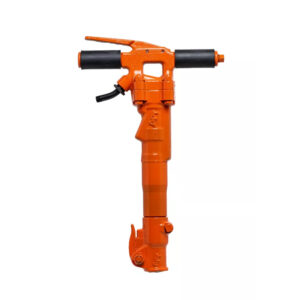
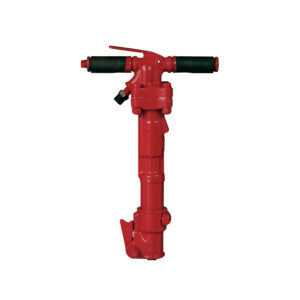
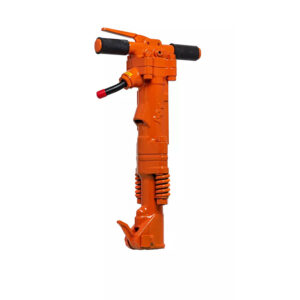
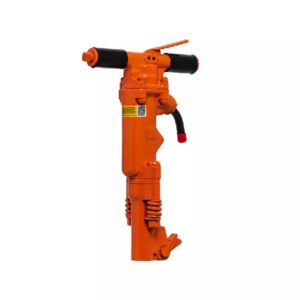
Running a power pack or working with no compressor? See the hydraulic (LH, BRK VR) and gas (Cobra PROe, Red Hawk) ranges in the full paving breaker category.
Full Spec Matrix
The four featured pneumatic breakers side by side. Hit the plus below to expand every paving breaker Crowder Supply carries — air, hydraulic, and gas. Every figure is from the model’s own spec table on crowdersupply.com.
| Model | Power | Class | Weight | Impact BPM | Air / Oil | Hex shank |
|---|---|---|---|---|---|---|
| APT 117 | Air | 30 lb | 33 lb | 1,850 | 34-38 CFM | 7/8×3-1/4, 1×4-1/4 |
| CP 1210 | Air | 40 lb | 44-55 lb | 1,410 | 48 CFM | 1×4-1/4, 1-1/8×6, 1-1/4×6 |
| APT 160 | Air | 60 lb | 70 lb | 1,680 | 60-65 CFM | 1-1/8×6, 1-1/4×6 |
| APT 190 | Air | 90 lb | 90 lb | 1,350 | 75-80 CFM | 1-1/8×6, 1-1/4×6 |
| More pneumatic breakers | ||||||
| CP 0112 | Air | 30 lb | 30-33 lb | 1,620 | 45 CFM | 7/8×3-1/4, 7/8×4-1/4, 1×4-1/4 |
| Tamco TPB-30 | Air | 30 lb | 33 lb | 1,550 | 49 CFM | 7/8×3-1/4, 1×4-1/4 |
| Texas TX30 | Air | 30 lb | 34 lb | 1,550 | 49 CFM | 7/8×3-1/4, 1×4-1/4 |
| APT 140 | Air | 40 lb | 43 lb | 1,500 | 48 CFM | 1×4-1/4 |
| Atlas RTEX 25 | Air | 40 lb | 55 lb | 845 | 37-38 CFM | 1×4-1/4, 1-1/8×6, 1-1/4×6 |
| CP 1260 | Air | 60 lb | 64-75 lb | 1,300 | 63 CFM | 1-1/8×6, 1-1/4×6 |
| Tamco TPB-60 | Air | 60 lb | 66 lb | 1,400 | 70 CFM | 1-1/8×6, 1-1/4×6 |
| Atlas TEX P60S | Air | 60 lb | 73 lb | 1,500 | 76 CFM | 1-1/8×6, 1-1/4×6 |
| CP 1290 | Air | 90 lb | 82-96 lb | 1,150 | 81 CFM | 1-1/8×6, 1-1/4×6 |
| Tamco TPB-90 | Air | 90 lb | 92 lb | 1,250 | 77 CFM | 1-1/8×6, 1-1/4×6 |
| Atlas TEX P90S | Air | 90 lb | 95 lb | 1,260 | 85 CFM | 1-1/8×6, 1-1/4×6 |
| Hydraulic breakers (run off a power pack) | ||||||
| Atlas LH 180 BSP | Hydraulic | — | 43 lb | 1,400 | 5.3 GPM | 1×4-1/4, 1-1/4×6 |
| Atlas LH 190 E | Hydraulic | — | 55 lb | 1,400 | 5.3 GPM | 1×4-1/4, 1-1/8×6, 1-1/4×6 |
| Atlas LH 190 E Tie Tamper | Hydraulic | — | 55 lb | 1,400 | 5.3 GPM | 1×4-1/4 |
| Atlas LH 270 | Hydraulic | — | 58 lb | 1,350-1,750 | 5-8 GPM | 1-1/8×6, 1-1/4×6 |
| Atlas LH 390 | Hydraulic | — | 73 lb | 1,150-1,600 | 8 GPM | 1-1/8×6, 1-1/4×6 |
| CP BRK 40 | Hydraulic | — | 56 lb | 1,400 | 5 GPM | 1×4-1/4, 1-1/8×6, 1-1/4×6 |
| Gas breakers (no compressor or power pack) | ||||||
| Atlas Cobra PROe | Gas | — | 53 lb | 1,440 | Gas, 44 ft-lb | 1-1/8×6, 1-1/4×6 |
| Atlas Cobra Combi | Gas | — | 55 lb | 2,700 | Gas (combi drill) | 7/8×4-1/4 |
| CP Red Hawk Road | Gas | — | 48 lb | 1,440 | Gas, 44 ft-lb | 1×4-1/4 |
The Complete Order, One PO
Everything to put a 60 lb APT 160 to work on day one — breaker, steel, air line, oil, and a safety cable — every item matched to the 1-1/8 x 6 in shank and 1/2 in NPT inlet. Change any option before adding.
APT 160 breaker
$1,378
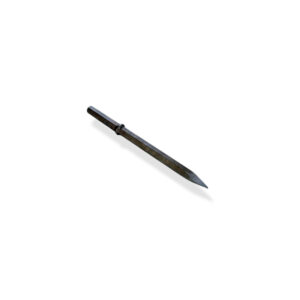
Steel starter pair
$91
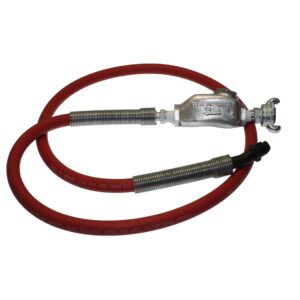
Whip hose + oiler
$142
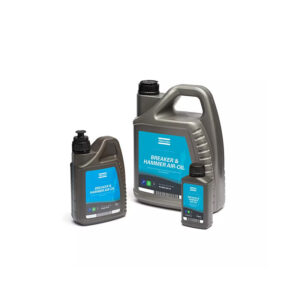
Air-tool oil
$38
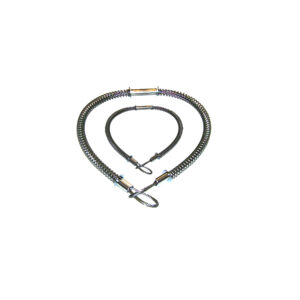
Whip-check cable
$11
Paving Breaker FAQ
What size paving breaker do I need?
Size by weight class and confirm with a field check. Use a 30 lb breaker for sidewalks, floors, and confined spaces; 40 lb for bridge decks and plant maintenance; 60 lb for general pavement, asphalt, and roadwork; and 90 lb for reinforced slab and foundation removal. Then watch the tool work: a normal-size piece should break off in about 10 to 20 seconds. Faster than that means step down a class; slower means step up.
Is a jackhammer the same as a paving breaker?
Yes. Jackhammer is the common name for the hand-held paving breaker — a vertical-use percussion tool that drives a point or chisel straight down into concrete, asphalt, and frozen ground. It is different from a rivet buster (the horizontal demolition specialist) and a chipping hammer (the lighter one-hand finisher).
How big a compressor do I need to run a paving breaker?
Match the compressor to the tool’s air draw with headroom. Live pneumatic breakers here draw from 34 CFM (30 lb APT 117) up to 85 CFM (90 lb Atlas TEX P90S) at 90 psi measured at the tool. A 90 CFM towable comfortably runs any single conventional breaker; a 185 CFM towable runs two heavy breakers at once. A starved breaker hits soft and wears itself out, so size up rather than down.
What shank size does a paving breaker use?
The industry has settled on four hex shank standards, sized across the flats by length under the collar: 7/8 x 3-1/4 in and 1 x 4-1/4 in for the 30 and 40 lb classes, and 1-1/8 x 6 in and 1-1/4 x 6 in for the 60 and 90 lb classes. Most heavy breakers are offered in both heavy shanks. The buying rule is simple: match whichever steel your crew already owns.
Should I choose an air, hydraulic, or gas breaker?
Let the power already on the job decide. If there is a compressor on site, go pneumatic — the widest choice and the default. If you run a hydraulic power pack or excavator circuit, an Atlas Copco LH or CP BRK VR breaker gives low-vibration breaking with no air line. If there is no compressor at all — remote right-of-way, sign and guardrail crews — a gas Cobra PROe or CP Red Hawk carries its own engine and goes anywhere.
What tool steel should I order with a new breaker?
At minimum a moil point and a wide chisel in the breaker’s shank size. The moil point is the universal concrete breaker; the 3 in chisel cuts, trims, and lifts. From there the same shank drives asphalt cutters, clay spades, ground-rod drivers, and tamping pads. Steel is consumable — it dulls and mushrooms first — so keep spares on the shelf.
Do paving breakers ship free?
Every air and hydraulic paving breaker ships free. Gas breakers — the Cobra PROe, Cobra Combi, and Red Hawk Road — ship at a fixed freight rate per order because of their size and the engine. Tool steel and accessories ship under standard terms.
Ready to break ground?
Every class in stock with free shipping on air and hydraulic breakers, 250+ steel and accessory SKUs, and a specialist a phone call away to size it right the first time.
