
Rock & Concrete Splitters · Buyer’s Guide
Split rock and concrete with zero blast, noise, or vibration
A hydraulic splitter cracks boulders, ledge, foundations, and mass concrete from the inside out — permit-free and one-person operated. This guide walks the five decisions that actually matter: how much force, which wedge, how much reach, which power source, and how many tools at once.
Splitter Class — At a Glance
Start With the Job, Not the Catalog
What are you breaking, and where?
A rock splitter is a portable hydraulic tool that drives a hardened central wedge between two counter-wedges inside a pre-drilled hole, forcing the material apart from the inside out to break rock, boulders, or concrete with no blasting, noise, dust, or vibration.
Silent demolition indoors
Foundations, slabs, columns and pile heads inside occupied or vibration-sensitive buildings.
Rock, ledge & boulders
Trench rock, quarry blocks and oversize boulders where blasting is banned or impractical.
Tight access & secondary
Confined spaces, shafts, and secondary splitting of oversize pieces for haul-out or recycling.
Mass / thick structures
Bridge decks, abutments, deep foundations and thick pillars that need maximum split force.
The Buying Logic
The five decisions, in order
Work top to bottom. Force and hole size are locked together, so start there; the power source and multi-tool question come last, once you know which cylinder you need.
Force vs. hole size
Bigger split force needs a bigger, deeper hole. Match both to the material.
| Concrete | 3,000–4,500 kN |
| Hard rock | 5,000–8,650 kN |
| Hole dia | 31–50 mm |
Configuration
Standard wedge for concrete; small / high-pressure wedge for hard rock in a tighter hole.
| Standard | concrete, wider hole |
| Small | rock, more force |
Reach & weight
Cylinder length sets minimum drill depth. Longer reach = thicker sections, more weight.
| Depth | 270–640 mm |
| Weight | 17–36 kg |
Power source
The pack is the engine. Pick electric, gas, air, diesel, or carrier-hydraulic to fit the site.
| Indoor | electric / air |
| Field | gas / diesel |
Tools at once
One pack can drive up to three cylinders through a multiplier module for faster, cleaner breaks.
| 1 tool | any pack |
| 2–3 tools | MM30 module |
The Part Everyone Under-Specs
Every splitter needs a power pack — pick the power source for your site
The splitter itself is just a hydraulic cylinder and a wedge. All the work is done by the power pack — a two-stage pump that delivers high-volume oil to open the cylinder fast, then switches to a high-pressure stage (up to 10,150 psi) to finish the split. What changes from pack to pack is the motor that drives the pump, and that choice is dictated by your jobsite, not the tool.
The default for indoor and enclosed work — no exhaust, lowest noise, steady power. Also the choice near hospitals, data centers, and occupied floors.
Darda EP3 · Tehma PP600-E / EC · PP700-E
Watch: needs 110–120V @ ~25A — a real circuit or a generator, not a household outlet.
The field workhorse. Drop it anywhere with no power supply and go — quarries, trenches, remote sites, open demolition.
Darda BP3 · Tehma PP600-S / PP700-S
Watch: engine exhaust rules it out for enclosed or poorly ventilated indoor work.
Ideal where shop air or a jobsite compressor already exists. No exhaust at the tool and a good fit for spark-sensitive or tunnel environments.
Watch: thirsty — the Tehma air pack wants ~127 CFM @ 100 psi, so size the compressor up.
Highest sustained output for big, remote jobs — runs long shifts and feeds multiple cylinders without breaking a sweat.
Darda D4 · D4E (electric start)
Watch: heavy and wheeled (Darda D4 ~302 lb) — a staged pack, not a carry-in unit.
Runs off an excavator or carrier’s auxiliary hydraulic circuit — no separate engine to fuel or maintain when a machine is already on site.
Watch: flow and pressure must match the tool; confirm the carrier’s aux circuit before ordering.
| Power pack | Source | Max pressure | Outlets / multi-tool | Weight | Live price |
|---|---|---|---|---|---|
| Darda Hydraulic Power Pack | Air / Gas / Electric / Diesel | 7,252 psi | Up to 3 tools | 88–344 lb | $13,265 |
| Tehma PP600 Power Pack | Air / Electric / Elec+Cooling / Hydraulic | 10,153 psi | Up to 3 (with MM30) | 67–116 lb | $8,530 |
| Tehma PP700 High-Flow Pack | Electric / Gas (Honda) | 10,153 psi | Up to 3 (with MM30) | 123–129 lb | $10,740 |
Pressures and weights from the manufacturer power-pack datasheets and the live Crowder Supply PDPs. “Live price” figures update to current pricing when viewed on crowdersupply.com.
The Lineup
Eight splitters, smallest to strongest
Every model below is a one-person hydraulic cylinder that runs off any of the power packs above. Prices are for the cylinder alone; add a power pack (or buy a matched combo) to complete the rig.
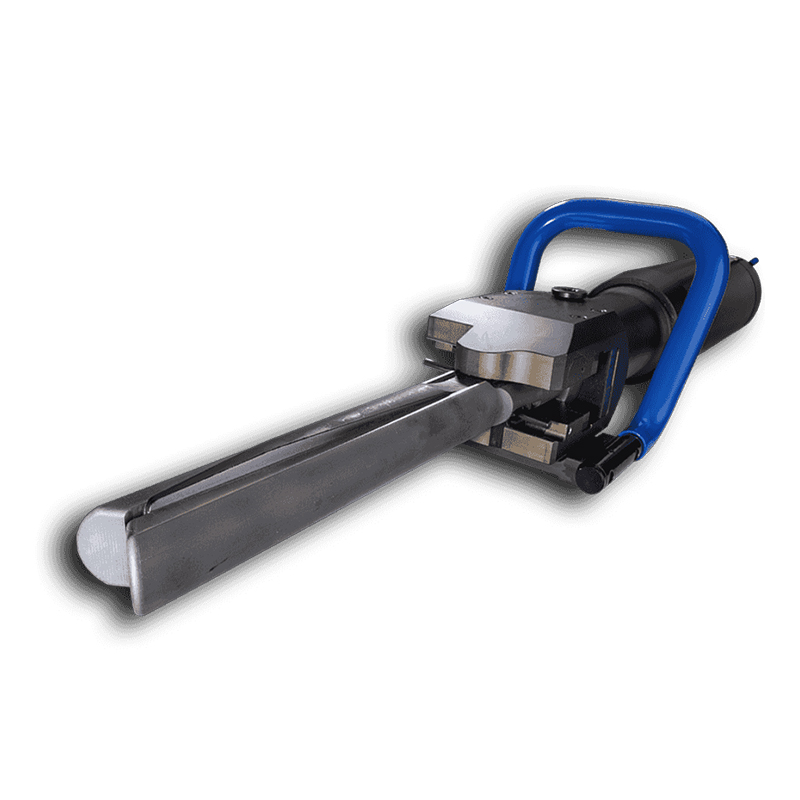
Tehma SP400
Best for: lightest full-size splitter — concrete and rock in tight spots.
View SP400 →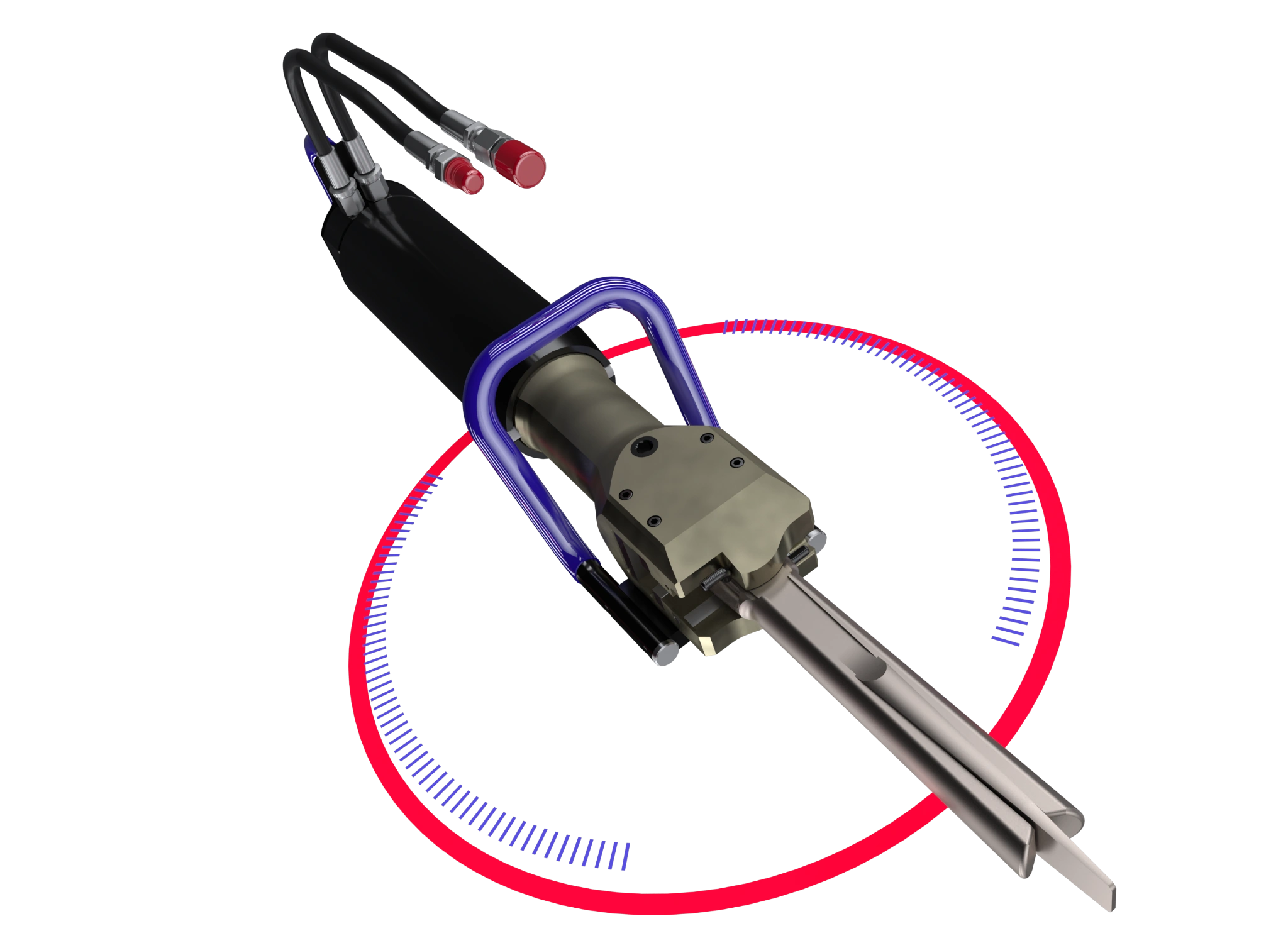
Tehma SP400-SW
Best for: hard rock — small wedge concentrates pressure for max force.
View SP400-SW →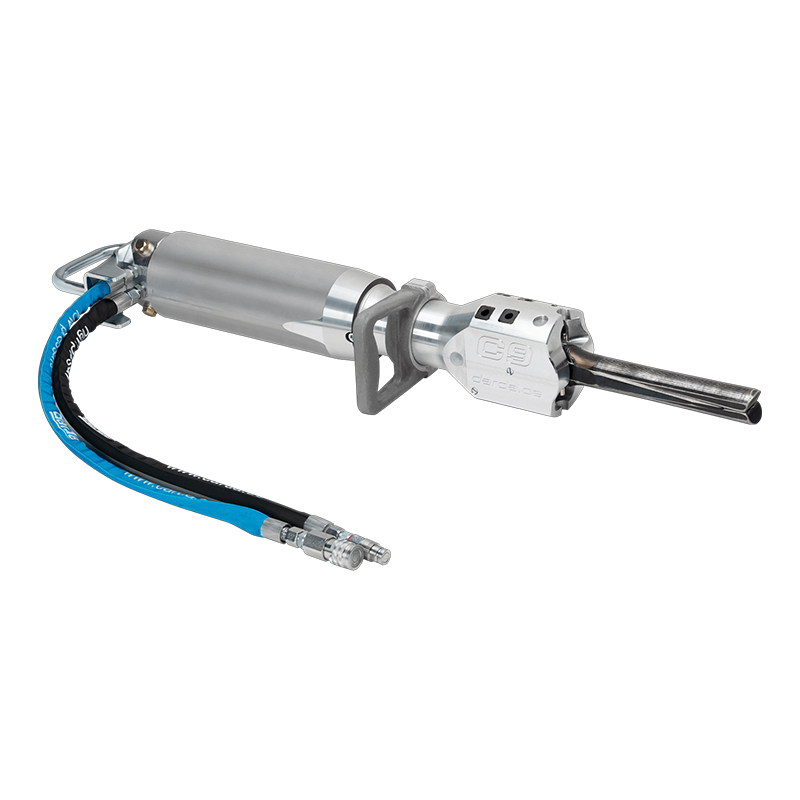
Darda C4E
Best for: handheld quarry blocks and indoor concrete demo.
View C4E →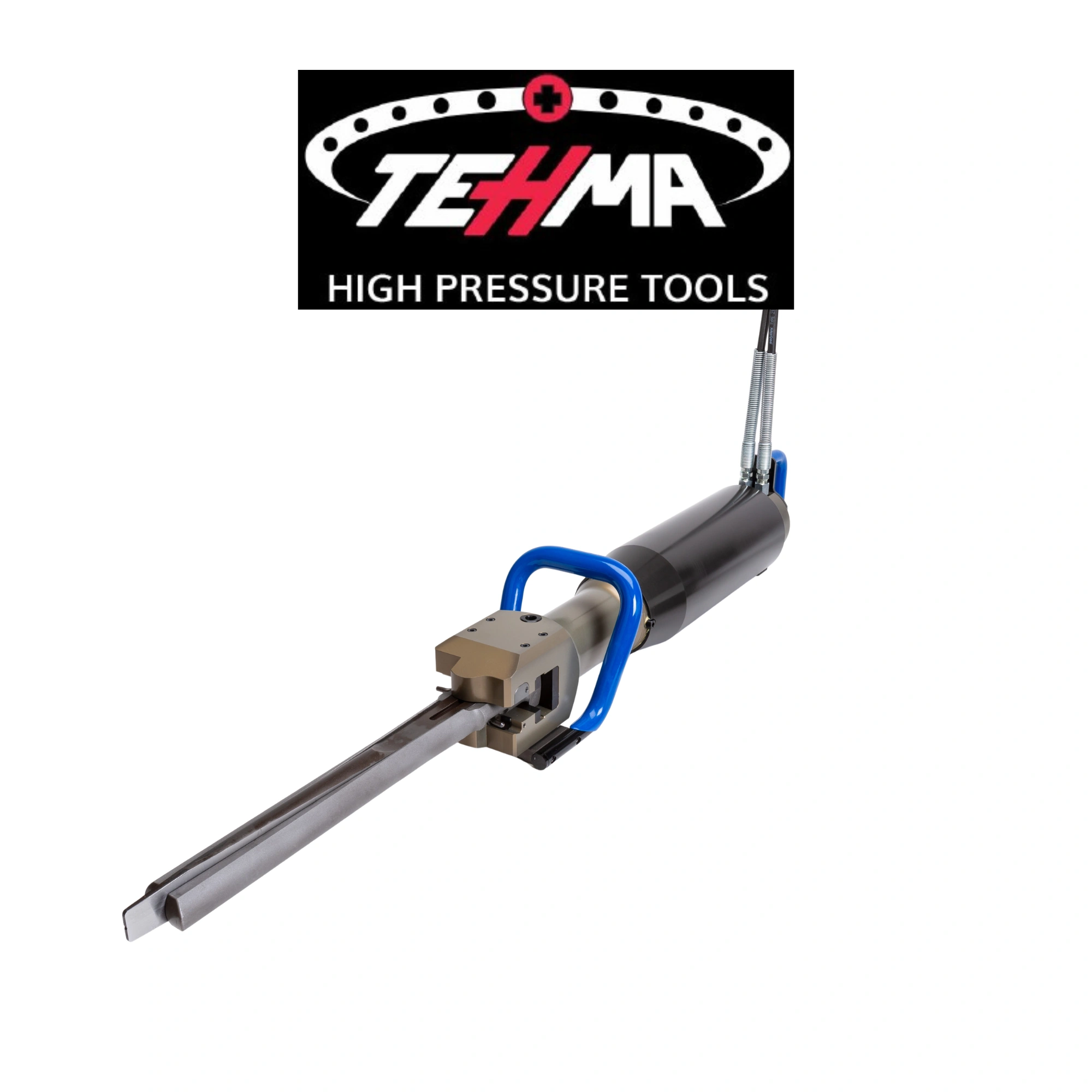
Tehma SP600
Best for: the most force of any model — thick mass concrete and hard rock.
View SP600 →
Darda C2S
Best for: the smallest hole and shallowest depth — precision secondary splitting.
View C2S →
Darda C9
Best for: reinforced concrete and confined-space demo with a shallow hole.
View C9 →
Darda C10S
Best for: deep holes in rock and thick sections — longest Darda reach.
View C10S →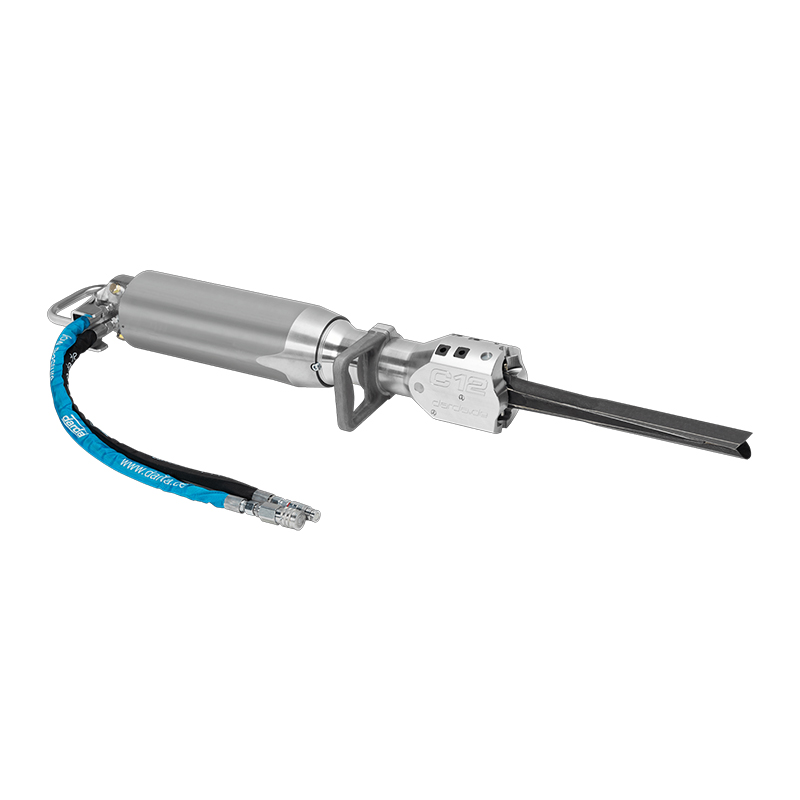
Darda C12
Best for: the strongest Darda — mass concrete, bridge and foundation demo.
View C12 →Every Model, Side by Side
Full specification matrix
| Model | Brand | Splitting force | Hole dia. | Min. drill depth | Split gap | Weight | Cyl. length |
|---|---|---|---|---|---|---|---|
| C2S | Darda | 783,000 lb-ft | 1-1/4 in | 10.6 in | 0.35 in | 37 lb | 29 in |
| C4E | Darda | 1,017,000 lb-ft | 1-3/8 in | 16.9 in | 0.39 in | 46 lb | 39 in |
| SP400-SW | Tehma | 1,367,000 lb-ft | 1-3/8 in | 17.5 in | 0.39 in | 51 lb | 41 in |
| C10S | Darda | 1,111,000 lb-ft | 1-5/8 in | 24.8 in | 0.70 in | 73 lb | 55 in |
| C9 | Darda | 672,000 lb-ft | 1-3/4 in | 16.1 in | 0.70 in | 49 lb | 40 in |
| C12 | Darda | 1,363,000 lb-ft | 1-3/4 in | 24.0 in | 0.75 in | 68 lb | 51 in |
| SP400 | Tehma | 814,000 lb-ft | 1-3/4 – 2 in | 17.5 in | 0.66 in | 52 lb | 41 in |
| SP600 | Tehma | 1,945,000 lb-ft | 1-3/4 – 2 in | 25.2 in | 0.59 in | 79 lb | 52 in |
Sorted by drill-hole diameter, smallest to largest. Splitting force shown in lb-ft (theoretical) from the Darda and Tehma manufacturer datasheets. Darda also publishes an effective force roughly 55-60% of theoretical; force depends on the wedge set fitted.
The Complete Rig, One PO
Everything a splitting crew needs to run day one
A splitter cylinder alone won’t break anything. This is the full working system — cylinder, power pack, hoses, spare wedges, and grease — built here around our best-selling Tehma SP600 rig. Swap the cylinder for any model above and the rest carries over.
Splitter cylinder
The tool. Our top seller, the Tehma SP600 delivers the most force of any model for rock and thick concrete.
Power pack
The engine. Pick your power source — electric for indoors, gas for the field.
High-pressure hoses
Feed and return lines rated to full splitting pressure; choose your length.
Spare wedge set
Wedges and counter-wedges are the wear part. A spare set keeps the crew cutting.
Wedge grease
Grease every wedge cycle — the consumable that keeps the wedge sliding and lasting.
Why Buy the Splitting Rig From Crowder
Darda
The original German splitter system — the C-series handheld cylinders, safe-wedge principle, and a full accessory tree of wedges, hoses, and power packs.
Shop Darda splitters & packs →Tehma
Italian-built SP400 / SP600 splitters and PP-series power packs, with the MM30 multiplier module for running up to three cylinders at once.
Shop Tehma splitters & packs →Rock splitter questions, answered
What’s the difference between a rock splitter and a hydraulic breaker?
A hydraulic splitter cracks material silently from inside a pre-drilled hole by forcing a wedge apart, while a breaker hammers it from the surface. The splitter produces no noise, dust, flying debris, or vibration, which is why it’s used near occupied buildings, in tunnels, and anywhere blasting or percussive breaking isn’t allowed. The trade-off is that a splitter requires you to drill a hole first.
Do I have to drill a hole before splitting?
Yes — every hydraulic splitter works in a pre-drilled hole. Diameter runs about 1.2 to 2 in and depth from 10.6 to 25.2 in depending on the model, drilled with a rock drill or a diamond core drill. The cylinder is inserted with the wedge retracted, then the hydraulic pressure drives the wedge to split the material outward.
Which power source should I choose for the power pack?
Match it to the site. Choose electric for indoor or enclosed work (no exhaust, quietest), gas/Honda for field jobs with no power supply, pneumatic where a jobsite compressor already exists (budget about 127 CFM), diesel for high-output remote work, and carrier-hydraulic when you can run off an excavator’s auxiliary circuit. The tool itself is identical; only the pump’s motor changes.
How much splitting force do I need — and how do Darda and Tehma compare?
For most concrete demolition, roughly 670,000 to 1,020,000 lb-ft (Darda C2S/C4E/C9 or Tehma SP400) is plenty. For hard rock, quarrying, and thick mass concrete, step up to 1,100,000 to 1,945,000 lb-ft (Darda C10S/C12 or Tehma SP600). Darda and Tehma are engineering equivalents that overlap across the range — pick by the exact force, hole size, and reach you need, and by which power-pack ecosystem fits your fleet.
Can I run more than one splitter at the same time?
Yes. A Tehma PP600 or PP700 with the MM30 multiplier module, or a Darda power pack, can drive up to three splitter cylinders simultaneously. Running two or three tools in a line of holes gives faster, straighter, more controlled breaks on large or high-precision work.
What’s the difference between the Tehma SP400 standard and small-wedge?
The small-wedge configuration (SP400-SW) uses a smaller wedge in a tighter 1-3/8 in hole, concentrating the pressure to deliver more force (1,367,000 lb-ft vs 814,000 lb-ft) for hard rock. The standard wedge uses a larger 1-3/4 to 2 in hole and a wider split gap, which suits concrete. The same SP400 cylinder converts between the two.
Is splitting really better than blasting or breaking?
For controlled, permit-free work near people and structures, yes. Splitting needs no explosives license, generates no vibration that could damage adjacent structures, and produces almost no noise or dust — so crews can work during business hours in hospitals, schools, and occupied buildings. For open, unrestricted bulk demolition, a breaker or excavator attachment may still be faster.
Ready to spec your splitting rig?
Tell us the material, the access, and where the power comes from — we’ll match the cylinder, wedge set, and power pack, and have it on a pallet to the lower 48.
