
Match the Rock Drill to the Hole You Have to Drill
Five decisions pick the right drill: weight class, configuration, chuck standard, dry or wet flushing, and the air to feed it. This guide walks all five with manufacturer-verified specs for every pneumatic and gas rock drill we stock – so the tool that shows up matches the rock, the hole, and your compressor.
Category Data Plate
Class capability per the reference chart below; air figures are manufacturer ratings at 90 psi. Actual tool weights run 8 to 72 lb; the 80 lb class S83 specs a 185+ CFM compressor.
Start With the Job, Not the Catalog
A pneumatic rock drill is a handheld percussion tool that hammers a drill steel with a free-flying piston while automatically rotating it between blows, flushing cuttings through the hollow steel, to bore blast, anchor, and utility holes in rock and concrete. Every drill we stock is a variation on that one machine – what changes is size, feed, and flushing. Find your job below and jump to the drills built for it.
Holes to 1-3/4 in. in concrete or rock: guardrail and sign anchors, rebar dowels, handrail posts, light demolition doubling.
Straight answer: a 9 lb drill handles 1-1/8 in. x 18 in. holes off a small compressor; step to a 15 lb class for 1-1/2 in. holes.Foundation and micropile holes, quarry bench work, line drilling, secondary breaking – drilled straight down, fed by body weight.
Straight answer: a 30 lb sinker drills to 36 in., a 60 lb to 96 in., and the 80 lb S83 to 25 ft. Drilling all day? The stand-mounted S83 Demon takes the vibration off the operator entirely.Drift development, narrow-vein mining, rock bolting – the drill needs a pneumatic leg to carry its weight and feed the hole.
Straight answer: the BTE Mid-Western S83 jackleg on an FL7 or TUL2B leg – the USA-made OEM continuation of the Gardner-Denver S83.OSHA and MSHA respirable-silica rules make dust control the first spec on many sites, not the last.
Straight answer: choose a water-flushed configuration – S83 wet, APT 137/155 wet versions, or the BBC 16W – and suppress dust at the bit.Remote anchor holes, ground rods, emergency utility work – past the end of the last air hose.
Straight answer: the gas-powered Atlas Copco Cobra Combi drills 29-40 mm holes to 2 m and breaks concrete with the same machine.The Five Decisions, In Order
Work these top to bottom and the catalog picks itself. Every figure is the manufacturer’s rating at 90 psi.
Class is an index of blow energy, not exact weight. Size it to hole diameter times depth.
| 9 lb | to 1-1/8 in. x 18 in. |
| 15 lb | to 1-1/2 in. x 24 in. |
| 30 lb | to 1-3/4 in. x 36 in. |
| 45 lb | to 2 in. x 72 in. |
| 60 lb | to 3 in. x 96 in. |
| 80 lb | to 4 in. x 25 ft |
Pick by the direction you drill and how the tool is supported.
| Sinker | downward, handheld |
| Jackleg | horizontal, on air leg |
| Stoper | overhead, leg-fed |
| Stand | S83 Demon, no operator load |
| Gas | combi drill, no air needed |
The chuck decides which drill steels and bits you buy – and they carry over between brands.
| 3/4 rd | 9 lb drills, whirlibits |
| 7/8×3-1/4 | 15-30 lb, hex steel |
| 7/8×4-1/4 | 30-60 lb standard |
| 1×4-1/4 | 60-80 lb heavy |
Wet injection suppresses respirable silica at the bit, cools it, and lifts cuttings – the compliance-friendly default in rock.
| Dry | air flush; control dust separately |
| Wet | S83W, APT 137/155 wet, BBC 16W |
Rate the compressor to the drill, keep pressure drop tight, and oil the air – always.
| 9 lb | 19-28 CFM, small portable |
| 15-30 | 32-73 CFM |
| 45-60 | 85-146 CFM |
| 80 lb | 185+ CFM tow-behind |
| Hose | 3/4 in. to 100 ft, 1 in. past |
Drill Class vs. Hole Size and Depth
The two most common rock drill mistakes: buying too little drill for the hole, and feeding it too little air. Find the hole you have to drill, buy the class that reaches it – and give it the CFM it needs at 90 psi.
Depths compressed for illustration – read the numbers, not the pixels. Air figures are manufacturer ratings at 90 psi; the 80 lb class S83 requires a compressor of at least 185 CFM.
One Right Answer Per Weight Class
Six drills cover the whole decision tree – one per class, plus the underground standard. Specs are manufacturer figures at 90 psi; prices are live and include free shipping.
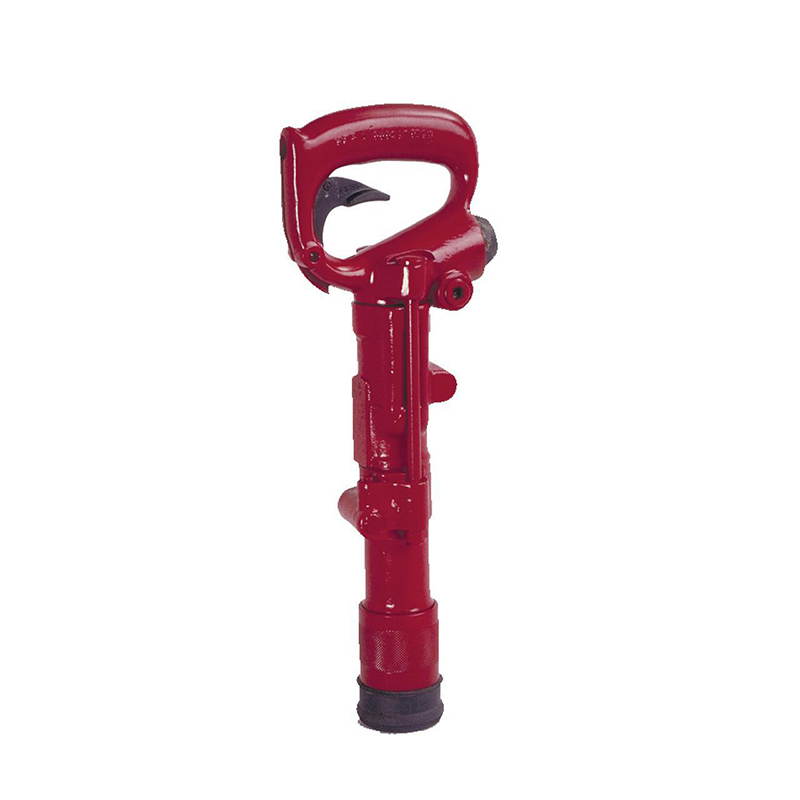
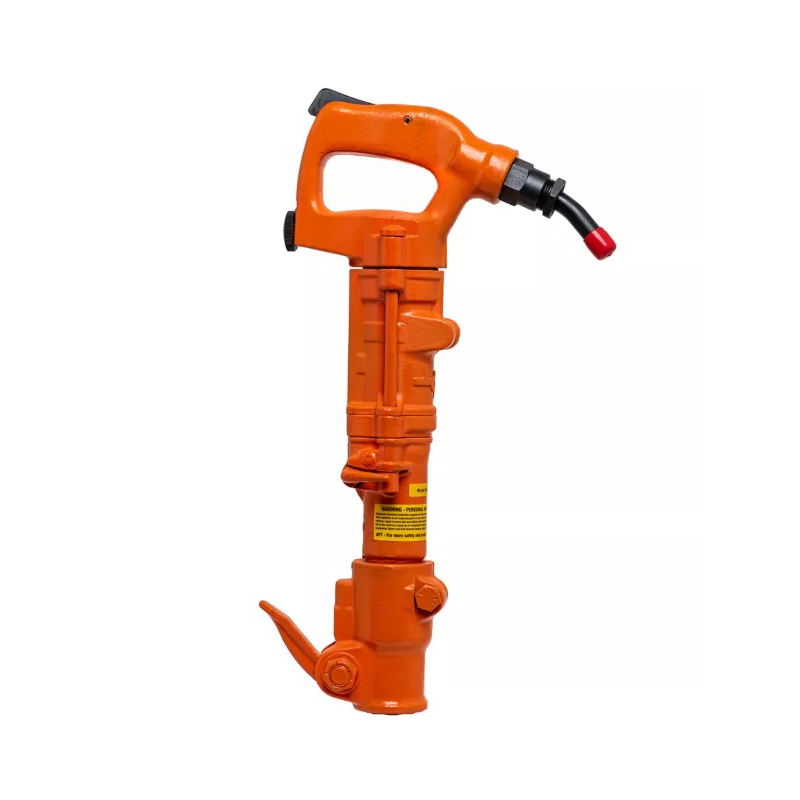
APT 115 – 15 lb class
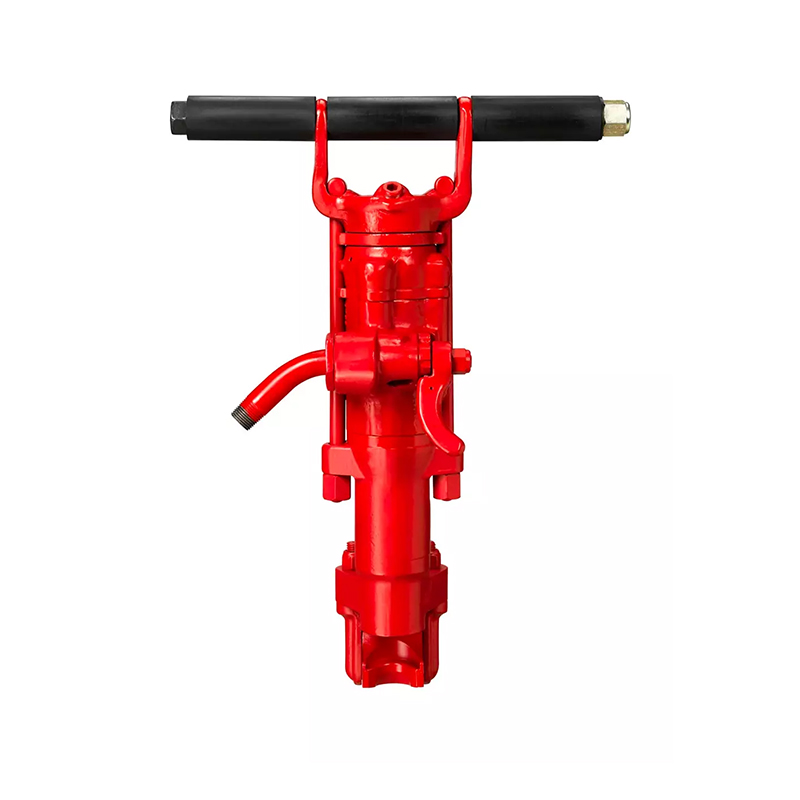
CP 0022 – 30 lb class
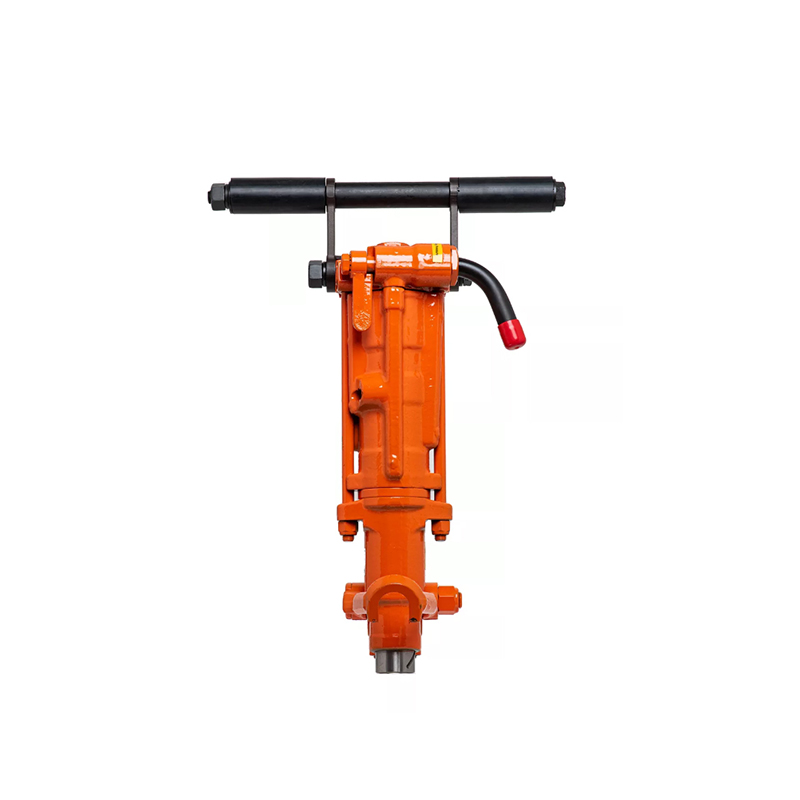
APT 137 – 45 lb class
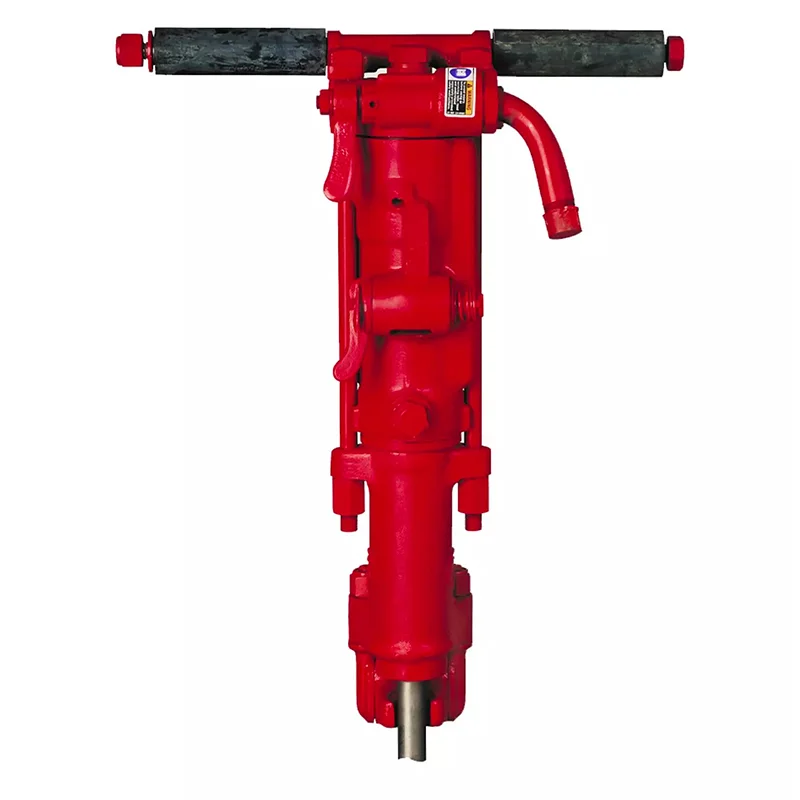
CP 0069 – 60 lb class
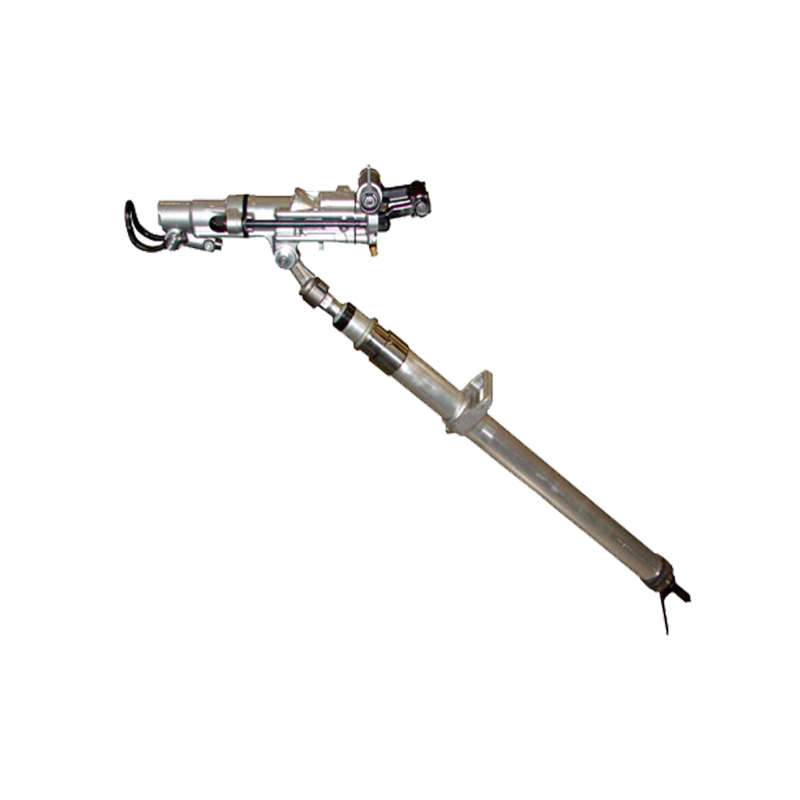
BTE Mid-Western S83 – 80 lb class
How a Pneumatic Rock Drill Works
A rock drill does two jobs at once: it hammers the drill steel with a free-flying piston, and it rotates the steel a few degrees between every blow so the bit always cuts fresh rock. That rotation – driven by the rifle bar and pawl mechanism – is what separates a sinker drill from a paving breaker. The exploded view below shows every major component in a CP 0022 class rock drill, from the T-handles to the steel retainer latch.

Exploded view, CP 0022 class pneumatic rock drill. Illustration for reference only – not to scale.
The operating cycle
- Air enters at the swivel inletCompressed air passes through the air inlet swivel and strainer. Squeezing the throttle handle opens the throttle valve and sends air into the backhead.
- The valve assembly directs the airA small automatic valve ports incoming air alternately to the back and front of the piston, dozens of times every second.
- The piston strikes the drill steelAir accelerates the free piston down the cylinder. Its face hammers the shank of the drill steel held in the chuck, sending impact energy straight into the rock.
- The rifle bar rotates the steelOn the return stroke, the piston’s rifled nut rides the spiral rifle bar. The pawls lock the bar against the ratchet ring, forcing the piston to twist – and the chuck turns the drill steel a few degrees with it.
- Exhaust, and the cycle repeatsSpent air exhausts as the valve flips, and the piston starts the next blow. Hammer plus rotation, over and over, is what bores a clean round hole.
What you’re looking at
The Full Line, One Table
Every pneumatic and gas rock drill we stock, with manufacturer figures at 90 psi. Class labels are trade convention – the weight column is the actual tool weight.
| Model | Weight | BPM | CFM @ 90 psi | Chuck options | Flushing | From |
|---|---|---|---|---|---|---|
| 9 – 15 lb light drills – anchor holes to 1-1/8 – 1-1/2 in. | ||||||
| CP 0009 | 8 lb | 3,420 | 20 | 3/4 round x 3-3/4 | Dry | $974 |
| APT 109 | 9 lb | 3,400 | 19-21 | 3/4 round x 3-3/4 | Dry | $1,017 |
| Tamco/Toku CP-9A | 9 lb | 3,400 | 20 | 3/4 round x 3-3/4 | Dry | $1,030 |
| Atlas Copco DKR 36R | 10 lb | 2,820 | 21 | 3/4 round x 3-3/4 | Dry | $1,199 |
| Tamco/Toku THD1100N | 11.4 lb | 3,200 | 28 | 7/8 x 3-1/4 hex | Dry | $1,396 |
| 15 lb class mid-weights – dowels and anchors to 1-1/2 in. | ||||||
| APT 115 | 19 lb | 2,900 | 32-36 | 7/8 x 3-1/4 hex | Dry | $1,762 |
| CP 0014RR | 15 lb | 2,520 | 32 | 7/8 x 3-1/4 hex | Dry | $1,774 |
| Texas Pneumatic TX18D | 17.75 lb | 2,900 | 36 | 7/8 x 3-1/4 hex | Dry | $2,490 |
| 30 lb class – the workhorse anchor/foundation class, to 1-3/4 in. x 36 in. | ||||||
| Tamco/Toku TJ-15 | 31 lb | 2,450 | 56.5 | 7/8 x 3-1/4 or 7/8 x 4-1/4 | Dry | $1,821 |
| CP 0022 | 32 lb | 2,220 | 56 | 7/8 x 4-1/4 hex | Dry | $2,074 |
| Texas Pneumatic TX29 | 29 lb | 2,700 | 73 | 7/8 x 3-1/4 or 7/8 x 4-1/4 | Dry | $2,490 |
| Atlas Copco BBD 12 D/T | 22-27 lb | 2,520-2,580 | 47-51 | 3/4 or 7/8 x 4-1/4 | Dry | $2,767 |
| 45 lb class – production drilling to 2 in. x 72 in. | ||||||
| APT 137 | 38 lb | 2,300 | 85-90 | 7/8×3-1/4, 7/8×4-1/4, 1×4-1/4 | Dry or wet | $1,887 |
| Tamco/Toku TJ-20 | 41 lb | 2,400 | 88 | 7/8 x 3-1/4 or 7/8 x 4-1/4 | Dry | $2,157 |
| CP 0032A / AS | 54-56 lb | 2,220 | 103 | 7/8×3-1/4, 7/8×4-1/4, 1×4-1/4 | Dry, wet kit avail. | $2,351 |
| Atlas Copco BBD 15E/ET | 34 lb | 2,520 | 47 | 3/4 or 7/8 x 4-1/4 | Dry | $3,551 |
| 60 lb sinkers – holes to 3 in. x 96 in. | ||||||
| Tamco/Toku TS-55 | 60 lb | 1,800 | 92 | 7/8×3-1/4, 7/8×4-1/4, 1×4-1/4 | Dry | $2,388 |
| APT 155 | 61 lb | 2,100 | 110-120 | 7/8×3-1/4, 7/8×4-1/4, 1×4-1/4 | Dry or wet | $2,485 |
| CP 0069 | 64 lb | 1,920 | 130 | 7/8 or 1 x 4-1/4 | Dry | $2,594 |
| Atlas Copco SRD 25E | 60 lb | 2,040 | 106 | 7/8 or 1 x 4-1/4 | Dry + blower | $2,630 |
| Texas Pneumatic TX60 | 61 lb | 2,250 | 98 | 7/8×3-1/4, 7/8×4-1/4, 1×4-1/4 | Dry | $3,465 |
| 80 lb class S83 (sinker & jackleg) – to 4 in. x 25 ft – underground & stand-mounted | ||||||
| BTE S83 Sinker (dry/wet) | 72 lb | 2,302 | 185+ CFM comp. | 7/8 or 1 x 4-1/4 | Dry or wet | $4,250 |
| BTE S83 Jackleg (FA-FD) | 72 lb | 2,302 | 185+ CFM comp. | 7/8 or 1 x 4-1/4 | Dry or wet | $4,500 |
| Atlas Copco BBC 16W | 62.8 lb | 2,340 | 146 | 7/8 x 4-1/4 hex | Water (built-in) | $5,533 |
| BTE S83 Demon (stand) | stand-mounted | 2,302 | 185+ CFM comp. | 7/8 or 1 x 4-1/4 | Dry or wet | $24,999 |
| Gas-powered – no compressor required | ||||||
| Atlas Copco Cobra Combi | 55 lb | 2,700 | gas, 2-stroke | 7/8 x 4-1/4 hex | Air (built-in blower) | $6,088 |
The Complete Order, One PO
A rock drill only drills with steel, a bit, air, and oil. This five-item kit is a matched, mechanically compatible system around the CP 0022 in the 7/8 x 4-1/4 chuck – every piece fits the others. Swap any item for your own spec with the browse button.
CP 0022 30 lb sinker – 56 CFM air draw runs with margin on a mid-size compressor. Product page
An H-thread shanked rod and carbide cross bit sized to the drill’s 7/8 x 4-1/4 chuck. Drill steel & bits
3/4 in. ID hose feeds this class without starving it – the pressure at the tool is what drills. Product page
Mounts in the air line near the tool and meters oil continuously – running dry is the fastest way to destroy a drill. Product page
Dedicated rock drill oil stays tacky in a wet air stream – motor oil does not. Match viscosity to the season. Product page
Bought by People Who Rebuild These Tools
Rock Drill FAQ
What size rock drill do I need?
Size the drill to the hole: a 9 lb class drill handles holes to 1-1/8 in. diameter and 18 in. deep; a 15 lb class reaches 1-1/2 in. x 24 in.; a 30 lb class 1-3/4 in. x 36 in.; a 45 lb class 2 in. x 72 in.; a 60 lb class 3 in. x 96 in.; and the 80 lb class S83 reaches 4 in. holes and 25 ft of depth. Beyond 4 in. or 25 ft, the conversation moves to rigs or down-the-hole hammers – call us. Class labels are an index of blow energy, not exact tool weight: actual weights in the line run from 8 lb (CP 0009) to 72 lb (S83).
How much air does a rock drill need?
Between 19 and 146 CFM at 90 psi, by class: 9 lb drills draw 19-28 CFM and run off a small portable compressor; 15-30 lb drills draw 32-73 CFM; 45-60 lb sinkers draw 85-130 CFM; and the underground drills draw up to 146 CFM, with the S83 jackleg spec’d for a compressor of at least 185 CFM. A 185 CFM tow-behind runs any single handheld drill in the line with margin. The pressure that matters is at the tool inlet, not the compressor gauge – use at least 3/4 in. ID hose up to 100 ft and 1 in. beyond, or a 100 psi compressor can deliver 70 psi at the drill.
What is the difference between a sinker, a jackleg, and a stoper?
They are the same percussion drill supported three different ways. A sinker drills downward, fed by the operator’s weight through the handles. A jackleg mounts the drill on a hinged pneumatic feed leg that carries its weight and pushes it forward, for horizontal and inclined holes underground. A stoper points straight up on a rigid leg for overhead work like roof bolting. Parts and drill steel largely interchange across all three.
Should I drill wet or dry?
Wet, wherever silica exposure is in play: water injected through the drill steel suppresses respirable dust at the bit, cools the bit, and improves cuttings removal. OSHA’s construction silica rule (29 CFR 1926.1153) and MSHA’s mine rule both set a 50 microgram permissible exposure limit, and wet drilling is the engineering control of choice. That is why wet configurations exist across the line – S83 wet, APT 137/155 factory wet versions, the water kit for the CP 0032A, and the water-flushed BBC 16W. Dry drills remain appropriate where exposure is otherwise controlled or the substrate carries low silica risk.
What drill steel and bits do rock drills use?
The chuck decides. The 9 lb drills take 3/4 in. round-shank steel with integral whirlibits. Everything bigger takes hex shanked rods in three cross-brand standards – 7/8 x 3-1/4, 7/8 x 4-1/4, and 1 x 4-1/4 in. – tipped with threaded carbide cross bits or button bits. Because the standards are shared, your existing steel and bits carry over between an APT, Toku, Texas Pneumatic, CP, or S83 drill with the matching chuck. Carbide button bits improve penetration 25-50 percent over integral steels in Atlas Copco’s published comparisons.
Rock drill, chipping hammer, or paving breaker – which one do I need?
A rock drill bores holes: it adds automatic rotation and through-steel flushing to percussion, which is exactly what chipping hammers and paving breakers lack. A chipping hammer (7.9-22 lb in our line) is a surface tool for cleaning, scaling, and controlled concrete removal. A paving breaker hits far harder with no rotation, for breaking slabs and rock mass. If the job is a round, sized, clean hole – anchor, blast, or utility – it is a rock drill job. Some 9 lb drills (the CP 0009 A and F trims, APT 109, TX-C9) include a rotation shut-off so one tool can do both light drilling and chipping.
Put the Right Drill on the Job
Order online with free shipping on every pneumatic rock drill, or talk through your rock, hole size, and compressor with someone who rebuilds these tools for a living.
